Nominal Is Not a Measurement: Making Peace With Timber's True Size
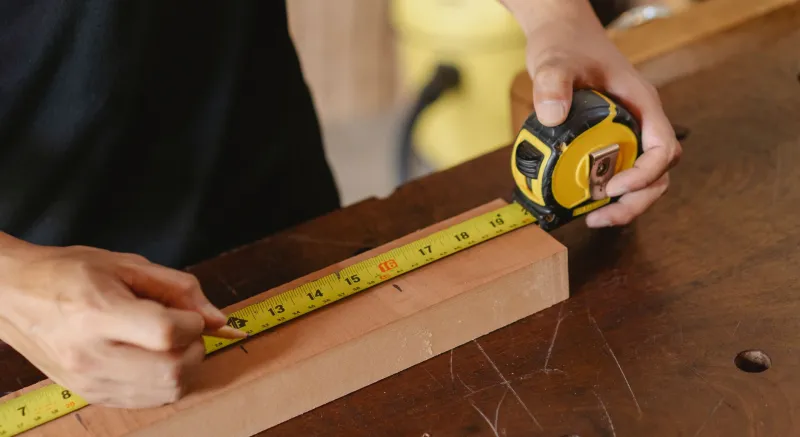
There’s a particular look on a customer’s face when they’ve just measured a “4x2” and found it isn’t four inches by two. It’s not anger, exactly. More like mild betrayal. They’ve bought timber before, they know a tape measure works, and yet the numbers on the label and the numbers in their hand have had a falling-out.
Good news: nobody’s trying to pull a fast one. Bad news: the label was never a measurement in the first place. It’s a name. And like most trade names, it has drifted a bit from what it originally described.
First, the name is a nickname
“4x2” comes from the old imperial nominal section. The “4” and the “2” describe the rough size the board was notionally cut from, not the finished piece you put a saw to. UK softwood is now specified in millimetres, and the trade still uses the old shorthand because it’s quick, familiar and fits on a ticket. A 4x2 is generally a 100×50mm nominal section. A 6x2 is around 150×50mm nominal. A 3x2 is around 75×50mm nominal. You get the idea.
But nominal means “in name only”. The moment the saw, the planer and the drying kiln have had their say, the actual size is smaller. That’s not a UK quirk. It’s how sawn timber works just about everywhere.
Sawn, regularised and planed are three different animals
This is where most of the confusion lives. A sawn board is just that: sawn. It will have saw marks, a rougher face and a size close to the nominal section but not identical to it. A nominal 100×50mm sawn softwood might arrive around 95×45mm. The mill has to allow for the saw kerf, the edges and the fact that a rough board is not a finished component.
Regularised timber sits in the middle. It’s been lightly planed, usually to ease the arrises and take off the worst of the saw marks, but it hasn’t been machined all round to a furniture-grade finish. It’s common for studwork and general construction, and the finished size is often close to the sawn size, but you should still ask.
Planed all round — PAR — is the one that really changes the numbers. Every face and edge gets machined, so the board loses a few millimetres in both dimensions. Depending on the spec, a nominal 4x2 that was around 95×45mm sawn can end up nearer 90×40mm once it’s PAR. That’s still a perfectly useful piece of timber. It just isn’t the size the old name suggests.
Moisture moves the target too
Timber is not a stable solid. It takes on moisture and gives it up, and it moves across the grain as it does so. Length barely changes, which is why a 2.4m board still measures roughly 2.4m. Width and thickness are where the action is. A board that’s been dried to a construction moisture content and then brought into a warm, dry room can lose another millimetre or two across its width as it settles.
That matters most for joinery and visible work. If you’re making a built-in shelf or a window lining, don’t cut everything to final size the day the timber lands. Let it acclimatise in the room where it’s going to live, then machine and fit. For structural work, the moisture content is specified for a reason, and the grade and treatment matter more than a millimetre of width. But the principle is the same: the size on the ticket is a starting point, not a guarantee for ever.
Tolerances are not a loophole
There are permitted deviations in timber sizes. Structural timber is covered by standards that set out how much a board can vary in thickness and width, and those tolerances often lean to the minus side. That’s not the yard being cheeky. It’s the reality of machining a natural material at speed. A 100mm nominal board can legitimately arrive a shade under 100mm, and a 47mm stud can be a fraction under 47mm.
The useful question isn’t “why isn’t it exact?” It’s “what am I actually being supplied?” A decent yard will tell you whether the ticket is sawn, regularised or PAR, what the finished size should be, and what tolerance applies. If they can’t answer that, you’re buying blind.
Ordering with your eyes open
Use the finished size in your calculations, not the name. This is where a lot of weekend projects go wrong. If you’re calculating board coverage for a fence or a shed lining, ten 95mm boards give you 950mm of cover, not 1000mm. If you’re setting out a stud partition at 400mm centres, the difference between a 95mm and a 100mm plate doesn’t ruin the wall, but it does change your noggin lengths and the lining detail. If you’re buying joist hangers, order them to suit the actual joist width, not the nominal one.
Allow a bit of waste as well. Five to ten per cent is sensible for general work, more if you’re cutting lots of short pieces or working around defects. For a deck frame or a floor, a couple of spare lengths are cheaper than a second trip.
What to say at the counter
Keep it plain. “I need 47×100 C16 for a stud wall. Is that sawn or regularised, and what’s the actual finished size?” If you’re buying PAR for visible work, say so and ask what the planed size will be. If you’re matching existing timber, bring a sample or a photo with a tape measure in shot. If you’re ordering for a specific calculation, do the sum on the finished size and write it down.
And bring your own tape. Not because the yard is trying to trick you, but because a quick check on a few boards tells you what you’re dealing with before anything gets cut. The label is a starting point. The tape is the truth. At Ashvale Timber, we’d rather you left with the right stock and no surprises than a tidy ticket and a nagging doubt.