Reading the Grain: How to Tell Timber Character From Trouble at the Yard
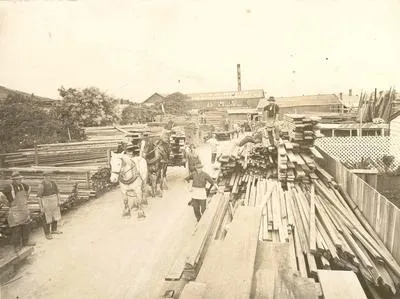
Photo: Unknown, Public domain, via Wikimedia Commons
A board can look rough as old boots and still be exactly right for a gate brace. Another can look clean and tidy and be a liability in a floor joist. That is the thing about timber defects: they are not a simple pass-or-fail list. They are information. The trick is reading them with the job in mind, not standing in the yard ticking boxes like a clipboard inspector.
At Ashvale we see plenty of buyers doing the right thing by turning boards over, checking ends and asking questions. We also see the opposite: someone grabbing the cheapest pack because it looks smart on the outside. So here is a yard-side guide to the defects that matter, the ones that are just character, and the ones that should have you walking away.
Start with the job, not the defect list
A garden bench and a stair stringer do not ask the same questions of a piece of timber. A painted exterior trim board can live with a small tight knot. A structural beam cannot live with a long shake running through its tension edge. A rustic cladding board can wear a waney edge like a badge. A cabinet door cannot.
Before you inspect a single board, decide three things: where it is going, what load it will carry, and how wet it will get. That turns a vague worry about defects into a practical test. You are not looking for flawless timber. You are looking for timber that is fit for the job in your hand.
Knots: live, dead and loose
Knots are where a branch met the trunk. A live knot is knitted into the surrounding wood and usually tight. A dead knot is darker, often ringed, and can come loose. Small live knots in ordinary joinery are rarely a problem. They can even add a bit of interest under a clear finish.
Dead knots are different. If you can pick at it with a fingernail and it moves, treat it as a hole waiting to happen. In a structural piece, a large dead knot on the tension edge is a reason to put the board back. In a thin panel, a loose knot can drop out and leave a void under veneer or paint. For a shelf, a knot near the end is mostly cosmetic. For a beam, it is not.
Shakes, splits and checks
A shake is a separation between growth rings, often caused by wind or stress in the living tree. Look at the end grain. A short check at the end of a board is often just drying movement and can be trimmed off. A long shake running down the length of the board is a different animal. If it opens when you flex the board, it is not character. It is a split waiting for a load.
Splits at the ends are common in cheap stock. If you are cutting the board down anyway, a short end split may be irrelevant. If you need the full length, price in the waste or choose another board. Do not let a bargain board with a long split talk you into a shorter project.
Waney edges and sapwood
A waney edge is the natural live edge of the log, bark and all. For rustic cladding, garden structures or a deliberately rough finish, it can be part of the appeal. For precise joinery, it is waste. You need to know how much clean square edge you are actually buying.
Sapwood is the paler wood just under the bark. It is softer and less durable than heartwood. In treated timber, sapwood can be fine if the treatment has penetrated properly. In oak for exterior use, sapwood is best kept out of wet details. It is not a reason to reject every board, but it is a reason to look at where the sapwood sits and what the weather will do to it.
Twist, bow and cup
Warping is the quiet defect that catches people out. A board can look fine flat on the rack and turn into a banana once it is cut and fixed. Sight down the length. Put it on a flat surface if the yard will let you. A slight bow can be pulled out in some fixings. A hard twist will fight you all the way through the job.
For doors, gates and frames, avoid severe twist. A board that rocks on the bench will rock in the frame. For small brackets or short cut pieces, you may be able to work around it. Again, match the defect to the use.
The quick yard inspection
Turn the board over. Check both faces and both ends. Look for fungal staining, insect holes, embedded grit and old nails. Damp timber is heavier and cheaper for a reason. If the yard will not let you inspect a board properly, walk away. A good yard expects you to look.
When to walk away
Walk away from structural timber with large dead knots, long shakes, rot, insect damage or severe twist. Walk away from exterior timber that is mostly sapwood and untreated. Walk away from fine joinery stock with waney edges where you need clean square sections. And walk away from any board that only works if you ignore what your hands are telling you.
Defects are not automatically bad. Bad defects in the wrong place are bad. A good board is not a flawless board. It is a board that suits what you are asking it to do.