Your Shed Is Not a Kiln: Getting Home Timber Storage Right
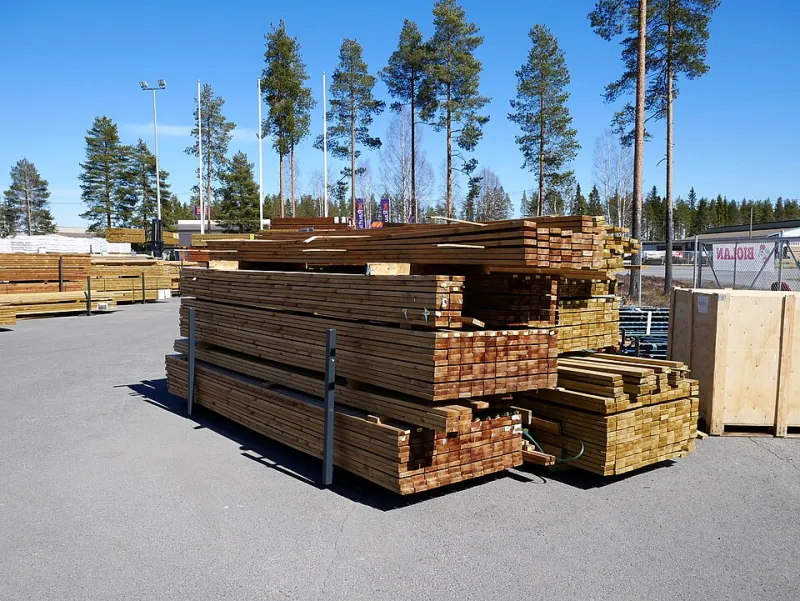
Photo: Santeri Viinamäki, CC BY-SA 4.0, via Wikimedia Commons
There's a particular kind of disappointment that comes with pulling a board off the pile six weeks after you bought it and finding it has decided to become a banana. You did everything right, you think. You put it in the shed. You covered it. You left it alone.
The trouble is that "in the shed, covered, left alone" is roughly the worst combination for timber in a damp climate. Wood doesn't fail because it gets wet once. It fails because moisture gets in and can't get back out, and a sealed shed with a tarpaulin over the stack is a very efficient way of arranging exactly that.
So let's talk about storing timber at home properly, in a garden the size most of us actually have.
Start With the Ground, Because That's Where It Begins
Timber wicks. Put a stack straight onto a concrete slab or a damp patio and the bottom layer will pull moisture up out of the ground like a straw, even under a cover. Give yourself 100mm of clear air minimum — a couple of spare bearers, some offcuts of 4x2, a pallet if you've got one going spare. Anything inert and dry that keeps the boards off the deck.
Don't use bricks laid flat in a row if you can avoid it. They're fine as a base but they hold the cold and they'll sweat. A pair of treated bearers running the full width of the stack is better, and they let you slide a hand underneath to check what's happening down there.
Stickers Are Not Optional
This is the bit people skip, and it's the bit that matters most. Every layer of boards needs to be separated from the one below by thin strips of dry timber — stickers, in the trade. Roughly 20–25mm square is plenty. The point isn't to make a fancy rack; the point is to let air move across both faces of every board.
Space them at 400–600mm centres along the length, and line them up vertically so the weight travels straight down through the stack rather than pressing a kink into the middle board. If you've only got six boards, you still sticker them. Especially if you've only got six boards — a lone board has nothing holding it flat.
Sawn offcuts work. So do cheap tile battens, cut down. What doesn't work is newspaper, cardboard, or old carpet. Those hold water against the face and you'll get staining and mould before you get anything useful.
Airflow Beats Cover, Every Time
Here's the hierarchy, and it's worth committing to memory: airflow first, shelter second, cover last. A stack that's open to the sides and roofed is far healthier than a stack that's wrapped up and sealed.
If you've got a lean-to, a carport edge, or even a gap between a fence and a wall that stays reasonably dry, that's better than the inside of a tight shed. In a small garden, the side of the house that faces away from the prevailing wind is usually the sweet spot — less driving rain, decent air movement, and you'll actually see the pile and remember it exists.
About That Tarpaulin
Tarpaulins are the single most common cause of ruined home-stored timber. The problem is that a tarp draped over a stack, tied down at the sides, creates a little greenhouse. Moisture comes up from the ground, condenses on the underside of the plastic, and drips back onto the boards. The wood never dries. It goes grey, then green, then soft.
If you need a cover — and for anything you care about, you probably do — then cover the top only, and overhang it by 150–200mm on each side. Leave the long sides open. Don't wrap it down. Weight the top with a couple of spare blocks so the wind doesn't take it, and check it after a gale.
Breathable membranes are better than plastic. A sheet of roofing felt is fine if it's kept off the wood itself. What you want is rain shedding off, not steam trapped in.
The Tight Shed Problem
A small shed with the door shut is a humidity trap. If that's all you've got, work with it rather than against it:
- Keep the stack off the floor on bearers, always.
- Sticker everything, even short lengths.
- Leave the door ajar on dry, breezy days — a couple of hours is enough to swap the air.
- Don't store timber against an outside wall that gets the weather; give it a 50mm gap so air can move behind.
- Never stack timber on top of anything damp — paint tins, bags of compost, that mystery box you haven't opened since 2019.
If the shed floor is bare earth or gravel, put down a sheet of DPM first, then bearers. You're cutting off the moisture source.
When to Stop Fussing
There's a point where looking after a pile becomes a hobby in itself, and it's worth saying plainly: timber is a building material, not an antique. If it's been stickered, off the ground, and under a roof that sheds water, it'll be fine for months.
What you shouldn't do is buy boards and leave them sitting for a year "until the project is ready". Timber stored badly for twelve months is worse than timber used at six weeks. If the stack has been sitting straight and dry for a season and you've got a free weekend, that's your signal. Get the saw out.
And a last word on buying: if you can, work out what you need and buy it close to when you'll use it. A yard that turns stock over will hand you boards in better condition than anything you can nurse back to health in a 6x4 shed. We'd rather you came back for the next project than spent the winter babysitting a pile you didn't need yet.
Stack it, sticker it, cover the top, then leave it alone — and mean it.