Short Ends, Real Work: Making the Offcut Pile Pull Its Weight

Photo: wooden offcuts short timber lengths stacked in workshop rack, via images-wixmp-ed30a86b8c4ca887773594c2.wixmp.com
There's a particular look people get when they ask for offcuts at the counter. Slightly apologetic, as if they're asking to rummage through the bins. They aren't, and they shouldn't be. A yard's short stock is the same timber as the boards on the rack — it's just been trimmed to length, or come off the end of a pack with a split in it, or been cut back so a customer could get a clean arris. None of that makes it scrap. Buying it badly does.
First, get the language right
Everyone in the trade uses slightly different words, so it pays to know which one you want.
- Shorts are the useful ones: roughly 300mm to 1.2m of sound, dry timber, usually from trimming to a cutting list.
- Offcuts is the broader term — anything left over, including pieces too short or too rough to build with.
- Rim or waney pieces are the edges of a sawn board with bark and sap on them. Cheap, but you're paying for waste unless you've got a plan for waney-edge work.
If you ring ahead, ask for 'kiln-dried shorts in the section I need' rather than 'any offcuts going'. The first gets you a bundle put aside. The second gets you whatever was swept up on Friday.
What's worth taking home
Sections matter more than species here. Small stock is only useful if the size suits the sort of work that uses small stock. In our experience the genuinely useful ones are:
- 18mm to 25mm boards — shelf stock, jig stock, drawer bottoms, box lids.
- 44 x 44 and 63 x 63 — legs, spacers, braces, garden frame work.
- 95 x 45 — the workhorse. Gate braces, shelf supports, bench aprons, studwork repairs on a shed.
- 25mm and 32mm square — glazing beads, edging, trim.
On species, be realistic about what a short end can do. Oak offcuts are lovely and hard as anything, but a 400mm piece of oak won't give you a table top. What it will give you is a pair of drawer runners, a mallet head, or a set of wedges. Tulipwood and poplar shorts are the best-value painted-work timber going. Larch or treated redwood shorts for anything outdoors. Utile and sapele for interior joinery where you want a bit of colour without paying oak money.
Walk past anything with nails, staples or old paint on it, anything visibly twisted over its length, and anything that's been sitting outside under a sheet since the spring. Also walk past boards under about 200mm unless you have a specific use — those are wedges and kindling, and you'll never get round to it.
Storing mixed shorts without breeding damp
This is where most home workshops fall down, and it's the reason people conclude offcuts are false economy. Boards go into a plastic tub on a concrete floor in November, and by February they're black and warped.
A few rules do most of the work:
- Get them off the ground. A bearer or two, or a shelf, is enough. Concrete wicks moisture straight into the bottom of a stack.
- Keep them off the wall. An inch of air at the back of a rack beats any amount of hoping.
- Stack flat with sticks between layers, or stand long pieces vertically in a rack with the ends off the floor.
- Sort by size, not species. You will never dig through a mixed pile to find a 600mm length of 45 x 95. You will always find it in the bin marked '45 x 95'.
- Date a bundle if you're unsure. Anything still untouched in twelve months was a bad purchase — and it's better to know that than pretend otherwise.
If your shed is properly damp, a cheap moisture meter is a better buy than another bag of shorts. Test before you cut, not after you've glued up.
Four jobs where shorts genuinely earn their keep
Bench furniture. Push sticks, bench hooks, a shooting board, a stop block for the mitre saw. These are 18mm and 25mm jobs, they get abused, and there's no reason on earth to cut them from a full board. A morning's work and you've got a set that lasts years.
Shelving with proper brackets. A set of chunky oak or utile brackets from 25mm stock, French-cleated to the wall, will hold more and look better than anything flat-pack. Offcuts are ideal because brackets are short by design — you're not fighting the timber.
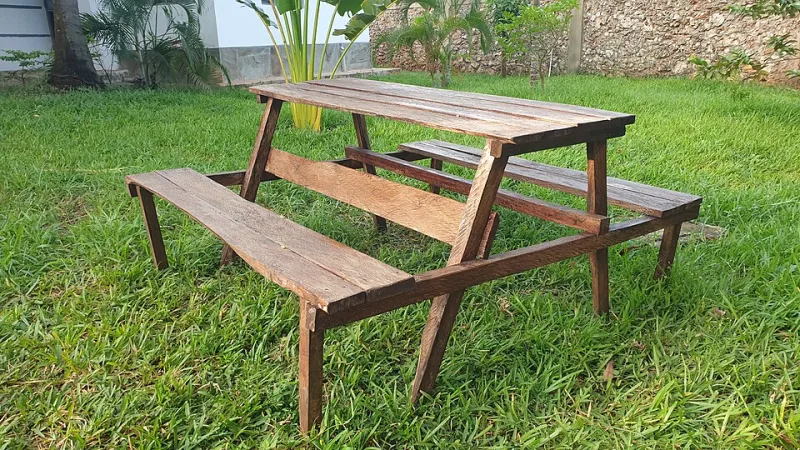
Garden repairs. Cold frame lids, raised bed edging, a new brace on a sagging gate, a replacement fence rail. Use larch or treated stock, stainless or galvanised fixings, and accept that a gate brace made from two pieces scarfed together is a perfectly sound repair if you do it neatly.
Small boxes and drawer inserts. 10mm and 12mm shorts, glued and pinned. Cutlery trays, tool drawers, a little box for the shed wall. It's the classic 'nothing job' that turns into a genuinely satisfying afternoon.
The honest economics
Shorts are cheaper per piece than per cubic metre, and that's the trap. A bin of mixed offcuts at forty quid feels like a bargain until you realise you've bought three useful lengths and a fortnight's worth of firewood. Buy to a project, not to a pile.
Our advice: go in with two or three jobs in mind, ask for the sections those jobs need, and take a dozen pieces rather than a sackful. Cut the defects off the moment you get home and square one edge. The real cost was never the timber — it's the space it takes up and the day you spend working around it.