Stock, Storage and Straight Answers: Judging a Timber Yard Properly
Anyone can sell you a plank. The difference between a yard that looks after its stock and one that merely has a forklift is obvious once you know where to look. At Ashvale Timber we are, admittedly, biased. But the checklist below is the one we would use if we were buying elsewhere — and it is the one we are happy for you to use on us.
A timber yard is not a showroom. You are buying a natural material that has been cut, dried, graded, stacked and moved. The board you take home is the end of that chain, not the start. If the chain has been sloppy, the board will tell you later, usually after it has been fitted.
Start with the shed, not the samples
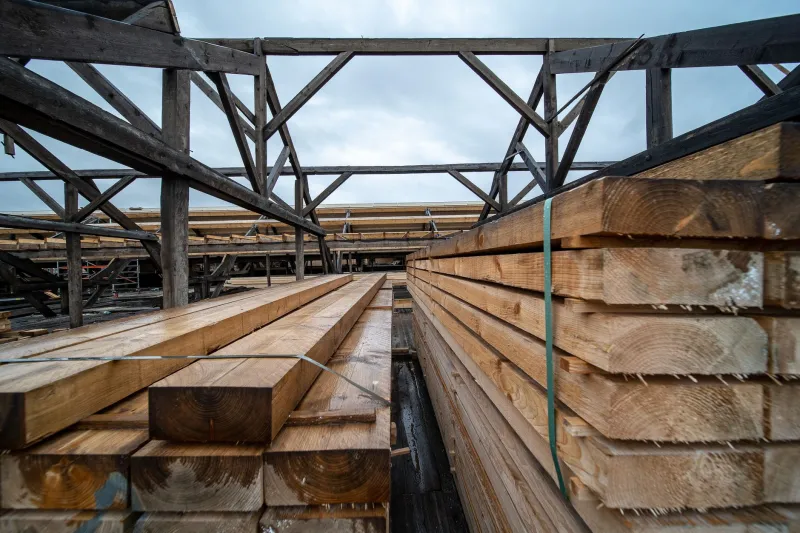
Walk past the neat display samples and look at the bulk stacks. Are they under cover? Are they off the ground? Is there air moving through the packs? Timber needs to be protected from rain and ground damp, but it also needs to breathe. A sheet of polythene draped tight over a pack is not protection; it is a little greenhouse. Good yards use proper covers, open sides, bearers and stickers between boards.
Look at the ends of the boards. End grain is where moisture gets in and out fastest. Sealed or waxed ends are a decent sign on higher-value stock. Damp concrete, leaning packs and covers that funnel water into the stack are not.
Ask how long the stock has been there. There is no shame in holding stock — there is shame in pretending it is fresh when it has been sat through three winters.
Ask for readings, not adjectives
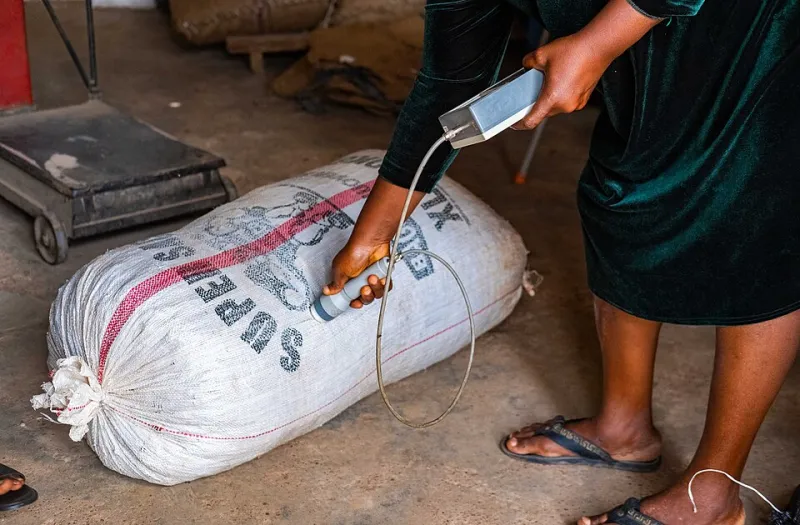
“Kiln-dried” is not a reading. It is a process. Ask what moisture content range the stock is in, when it was tested and whether they will put a meter on a few boards while you are standing there. A decent yard will not be offended by this. If anything, they will be pleased you asked.
Take readings from several boards, not one. Meter pins should go into the face or edge properly, and the reading should be in the range the yard quoted. A single board at 9% and another at 18% in the same pack tells you the stack is not uniform. That matters more than the average.
If the yard cannot tell you the difference between kiln-dried and air-dried, or cannot explain why one might suit your job better, treat that as information. It does not automatically mean the stock is bad. It does mean you are buying blind.
Grading has to be specific
“Good quality” is not a grade. Ask what the stock is graded to, who graded it and what defects are allowed. For joinery, you want to know about knots, shakes, waney edges and twist. For structural timber, you want the strength class and the mark. For cladding, you want to know about knots and grain, because they affect how it weathers and how it fixes.
A yard that grades honestly will tell you what a pack is not suitable for. That is more useful than a boast about how good everything is. If every board is “the best you can get”, ask why there are three grades on the price list.
Watch the offcut policy and the saw
The cutting service tells you a lot. Is the saw set up properly? Are cuts charged per cut or per minute? Can you buy a short length without paying for a full board? What happens to offcuts — are they sold, given away or skipped?
A good yard will be clear about all of this before you order. A yard that gets vague about waste, cutting tolerances and minimum quantities is a yard that will get vague about the bill.
Delivery is part of the product
Timber that arrives damaged is not good stock. Ask how it will be delivered: covered vehicle, flat bed, crane, kerbside only? Who unloads it? What access do they need? Is there a damage policy, and who pays if a pack arrives with broken boards?
It sounds boring until you are standing in the rain with a pallet of cladding and no fork lift. The best yards will talk you through access and handling before they take the order, not after.
The questions worth asking
Before you spend a penny, ask:
- Can I see the actual pack, not just a sample?
- What is the moisture content range, and can we take a few readings?
- Is this kiln-dried or air-dried, and what is it intended for?
- What grade is it, and what defects should I expect?
- How long has it been in the yard, and how has it been stored?
- What is the cutting and offcut policy?
- How will it be delivered, and who unloads it?
- What happens if the stock is not as described?
The tell-tale signs
Good signs: clean stacks, dry bearers, staff who know the stock, batch information, honest answers about what a board is not good for, and a willingness to let you look. Bad signs: vague answers, covers that trap water, packs sitting on damp ground, no stickers between boards, and a sales pitch that starts with price and ends with “it will be fine”.
At Ashvale Timber we would rather sell you the right board once than the wrong one twice. Good stock is only half the story. The other half is a yard that can explain what it has, how it has kept it and what you should do with it when you get it home. Come and kick the tyres.